Ground Rules for Late-Night Sessions
A late session is an arithmetic problem before it is a habit: the hour spent at one in the morning is paid for the next day, and the bill arrives late enough to be easy to miss. Sixteen sessions a month at an hour each is 16 hours, and if two thirds of them begin after 23:00 that is roughly 11 sessions moved into the window you need for sleep. Crushon keeps continuing conversations in their own area and publishes a weekly chart, which means the pattern is visible whenever you decide to look at it.

Key takeaways
- Count late sessions, not all sessions: two thirds of 16 monthly sessions is about 11 after 23:00.
- Wind-down costs more than the session. A session that ends at 00:00 usually compresses 90 minutes of preparation for sleep.
- Eleven late sessions at 90 minutes each is 990 minutes, or 16.5 hours displaced from the sleep window in a month.
- Move the window, not the habit: starting two hours earlier changes the arithmetic without removing the activity.
The arithmetic of a late session
Most people measure a session by its length and forget the tail: the ten minutes after it ends, when the thread is still running through your head, and the further half hour before sleep actually arrives. Call it ninety minutes of displaced wind-down for a session that finishes at midnight. That figure is an illustrative assumption rather than a measurement, and it is deliberately conservative.
The reason to treat the tail as part of the cost is that it is the part you cannot shorten by typing faster. A session has a natural end — a scene finishes, a thread reaches a pause — while the transition afterwards is entirely within your control, provided you leave enough time for it. The practical rule that follows is simple: the session ends when it ends, but it must end early enough for the wind-down to still exist.
The morning-after check
There are three effects worth checking for rather than assuming. The first is the obvious one: how long it took to get to sleep, and whether that shifted your morning. The second is whether the following day's sessions started earlier to compensate, which produces a drifting schedule rather than a fixed one. The third is the weekend correction, where a week of late nights is paid back in a long sleep — a pattern that hides the cost during the week and makes it visible only on Sunday.
None of these need to be treated as problems. A reader who checks them once a week has the information required to decide whether the current window is working, and the decision is usually about timing rather than about the activity itself.
| Rule | What it protects | If it fails |
|---|---|---|
| Hard end time 90 minutes before lights-out | The full wind-down, not a compressed one | Start the session earlier by 30 minutes |
| One long session per evening, not two | Avoids a second wind-down cycle at 01:00 | Move the second thread to the next day |
| Close the scene rather than pausing mid-beat | Sleep, and an easy resume tomorrow | Spend the last five minutes writing a closing line |
| Weekly check of late-session count | Catches a drift before it settles in | Recount and reset the window |
| No new threads after a set hour | Keeps long arcs out of the smallest hours | Continue an existing thread instead |
Worked example: 11 late sessions in a month
Start with the session pattern. Four sessions a week for four weeks is 16 sessions a month, which is 4.0 hours at 15 minutes each, 8.0 hours at 30 minutes, and 16.0 hours at 60 minutes. Assume, illustratively, that two thirds of those sessions start after 23:00: 16 × 0.667 ≈ 11 late sessions.
Now attach the tail. If each late session displaces 90 minutes of wind-down, the monthly total is 11 × 90 = 990 minutes, or 16.5 hours — more than the entire 16-hour month of conversation at the one-hour pattern. Suppose the rule changes to a hard end 90 minutes before lights-out. For a reader with a 23:30 bedtime that means sessions finish by 22:00, which at an hour each requires starting at 21:00. The number of sessions does not change; only their position in the evening does.
The comparison worth keeping is between 16.5 hours of displaced wind-down and the 16 hours of actual conversation. When the tail is nearly as large as the activity, moving the window by ninety minutes is the highest-value change available — and it costs nothing except the decision.
Two cards to watch, and one page to read
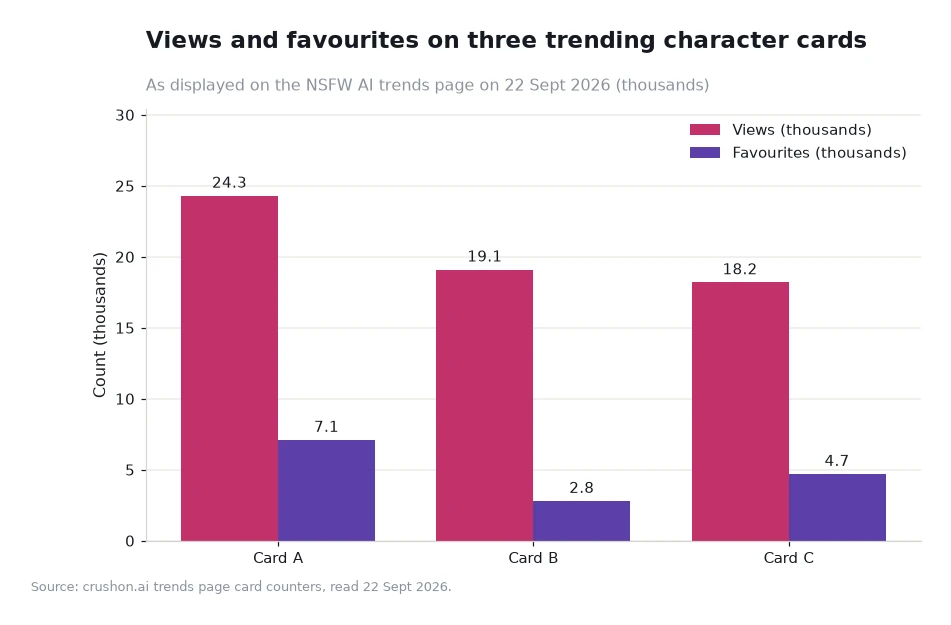
There is a mild consolation in the counters: reading is slow and attention is not. On 22 Sept 2026 the leading card carried 24.3M views and 7.1K favourites, a rate of about 0.029%, while the third card carried 18.2M and 4.7K, a rate of 0.026%. Even the most opened character on the platform converts only a few hundred of every million views into saves — which is a useful reminder that there is no such thing as being late to something here. Nothing expires because you closed the app an hour earlier.
If the evening pattern is going to change, it is worth knowing what the product does with a thread between sessions. The platform's description of its ai porn chat area explains how characters recall previous interactions and adapt over time, and its FAQ answers the more basic questions — what Porn Chat AI refers to, how realistic the responses are described as being, and which limitations apply under the content and community guidelines. The dated 2257 compliance statement settles what the content itself is. Reading those three pages takes about the same time as one short session, which is exactly how much you are trying to protect. Anyone looking for a reason to close a thread rather than push it later can also check the weekly NSFW AI trends chart in the morning: a card that gained a few thousand views overnight will still be there on Thursday.
Frequently asked questions
How many late sessions are too many?
There is no universal number, but 11 late sessions a month out of 16 is a majority, and it is worth questioning whether that is a choice or a default. A useful test is whether the following mornings feel unchanged.
Is it better to shorten sessions or start earlier?
Starting earlier changes the arithmetic without reducing what you get. Shortening a session often means stopping mid-scene, which costs continuity, so moving the window is usually the cheaper correction.
Does closing a thread early lose progress?
No. Continuing conversations are kept separately from the character list, so a thread closed on purpose can be resumed later. What is lost is only the sense of an unfinished evening.
Move the window, keep the habit
Set a hard end time ninety minutes before you intend to sleep, open one thread rather than two, and close the scene with a deliberate line before you stop. Then check your late-session count once a week for a month. The activity stays exactly as it was; it simply stops borrowing from the following morning, and the arithmetic above shows how much that is worth. Nothing about the stories has to change for the arithmetic to improve, which is why timing is the easiest variable to move.
Data and sources: the counters displayed on the NSFW AI trends page and the platform's own product description[1], read 22 Sept 2026. Wind-down and late-session figures are illustrative assumptions, not platform data. Written for adults 18+.