How Do custom hydraulic hoses Handle Extreme Temperatures?
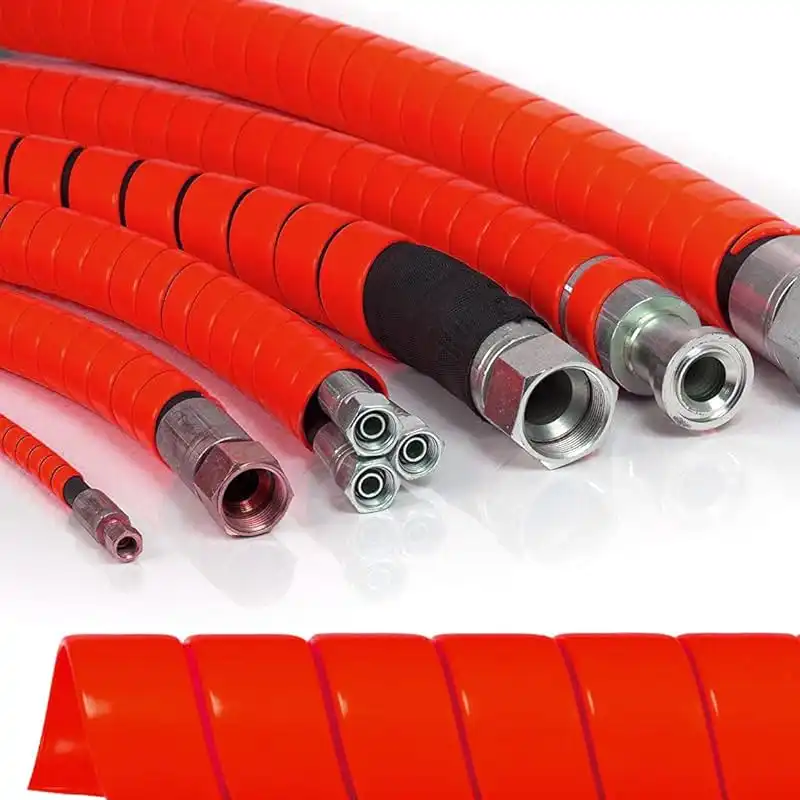
Custom hydraulic hoses handle extreme temperatures by matching the tube, reinforcement, cover, fittings, and hydraulic fluid to a defined operating range rather than relying on one temperature rating. Standard petroleum-oil hydraulic hoses commonly work around −40°C to 100°C, while selected constructions can reach about 125°C to 150°C under manufacturer-approved conditions. At high temperature, elastomers age faster and some hose types require pressure derating; at −40°C, compounds stiffen and bending becomes harder. SAE J517 and ISO hose standards use specified temperature, pressure, impulse, and bend requirements, so a properly engineered assembly must satisfy all four conditions at the same time.
A hydraulic hose does more than contain hot or cold oil. Its inner tube must resist the fluid, the reinforcement must contain pressure, and the outer cover must tolerate abrasion, ozone, weather, and external heat. A common high-pressure hose may have one or two steel-wire braids, while higher-pressure constructions can use four or six spiral-wire layers. SAE J517 specifications have been used for decades to define dimensional and performance requirements for many hydraulic hose families, including temperature and impulse testing. A hose marked for 100°C continuous oil service should not automatically be treated as suitable for 120°C simply because the machine only reaches that temperature for short periods.
That temperature limit becomes more important because heat speeds up chemical aging. A widely used engineering rule is that many polymer-aging reactions can increase by roughly 2× for each 10°C rise in temperature, although the exact rate depends on the compound and fluid. A hose operating continuously at 110°C can therefore age much faster than the same construction at 90°C. Nitrile rubber, or NBR, is widely used with petroleum-based hydraulic oils because it balances oil resistance, flexibility, and cost, but different NBR formulations have different upper and lower temperature limits.
High-temperature performance should be based on fluid temperature at the hose wall, not only the temperature shown on a reservoir gauge.
The oil entering a hose can be hotter than the surrounding air, while a hose routed beside an exhaust manifold can face the opposite situation: the oil remains within its approved range, but the cover receives strong radiant heat. In mobile machinery, engine compartments may expose hose surfaces to localized temperatures well above 100°C, even when ambient air outside the machine is below 40°C. Surface contact with a hot exhaust part is more severe because heat transfers by conduction rather than radiation. For that reason, routing distance, heat shielding, and sleeve selection are part of temperature control rather than optional accessories.
A protective sleeve can reduce external heat exposure, but its rating must be read carefully. Silicone-coated fiberglass sleeves are commonly sold in continuous service classes around 260°C, with much higher short-duration exposure ratings depending on construction. Those figures describe the sleeve, not the hydraulic hose underneath it. If a hose tube is approved for 100°C oil, wrapping it in a 260°C sleeve does not convert it into a 260°C fluid hose. The sleeve mainly slows external heat transfer and protects the cover from short periods of radiant or splash exposure.
High temperature also affects pressure capability. Thermoplastic materials and elastomers generally lose stiffness as temperature rises, so some manufacturers publish pressure-reduction factors for operation above a reference temperature. A hose rated at 350 bar at ordinary conditions may require a lower allowable working pressure near its upper temperature limit, depending on the exact construction. A 20% pressure reduction can be more important than a 20°C temperature increase when both occur close to the published limits. Manufacturer pressure-temperature tables should therefore be used rather than assuming the printed maximum working pressure applies at every approved temperature.
| Operating condition | Typical engineering concern | What should be checked |
|---|---|---|
| −40°C startup | High oil viscosity and stiff hose compounds | Low-temperature flexibility, bend radius, startup pressure |
| 80–100°C continuous oil | Long-term elastomer aging | Tube compatibility, cover temperature, service interval |
| 120–150°C fluid | Limited material choices | Manufacturer temperature rating and pressure derating |
| Radiant heat above 150°C | Cover degradation | Routing clearance, shield, rated thermal sleeve |
| Repeated hot/cold cycles | Expansion and contraction | Fittings, seals, reinforcement fatigue, inspection frequency |
Cold operation creates a different set of problems. Many hydraulic hoses are rated to approximately −40°C, while special low-temperature products can be designed for lower service temperatures. The rating alone does not describe how easily the hose bends after hours in cold weather. Rubber becomes stiffer as temperature falls, and hydraulic oil can become several times more viscous than it is at 40°C. ISO viscosity grades illustrate the effect: an ISO VG 46 oil has a nominal kinematic viscosity of about 46 mm²/s at 40°C, but viscosity rises sharply as the oil approaches freezing conditions.
Thicker cold oil increases pressure loss through hoses, fittings, valves, and filters. During a −30°C startup, a pump may therefore experience substantially different inlet and outlet conditions from the same machine operating after the oil reaches 50°C. If the hose is also forced to flex immediately, the colder tube and cover see mechanical strain while internal pressure is rising. A low-temperature custom hydraulic hoses specification should therefore include minimum ambient temperature, minimum fluid temperature, movement frequency, required bend radius, hose length, and expected startup pressure rather than one low-temperature number.
Bend radius matters because temperature changes how strain is distributed through the hose wall. A hose installed below its published minimum bend radius places extra strain on the reinforcement and tube even at room temperature; at −40°C, reduced flexibility can make the same routing less tolerant. SAE and ISO hose specifications commonly define minimum bend radii by hose size and construction. A 1/2-inch braided hose and a 1-inch multi-spiral hose can have very different bend requirements, so copying the routing geometry from one hose size to another can shorten service life.
Fittings introduce another temperature boundary. Steel fittings can tolerate temperatures far beyond many elastomer tubes, yet the seal inside the connection may have a narrower usable range. Common NBR O-rings are often specified around −40°C to 100°C or 120°C, depending on grade, while FKM seals are frequently chosen for higher-temperature petroleum-fluid applications and may operate near 200°C in suitable service. EPDM offers different chemical compatibility and should not be assumed suitable for petroleum oil merely because its temperature range looks attractive.
The assembly temperature rating is normally limited by the lowest-rated compatible component: hose tube, cover, seal, fitting system, or fluid.
Fluid chemistry can change the acceptable range again. Petroleum hydraulic oils, water-glycol fluids, phosphate-esters, biodegradable esters, and synthetic fluids do not interact with elastomers in the same way. A tube compound that remains physically stable at 120°C in one fluid may swell, harden, soften, or lose adhesion in another. ISO 1817 is widely used for assessing the effect of liquids on vulcanized rubber and thermoplastic elastomers by measuring changes such as mass, volume, hardness, and tensile properties after controlled exposure.
Reinforcement architecture must also match the pressure cycle. Braided-wire hoses are common on medium- and high-pressure equipment because they combine flexibility with pressure capacity. Four- and six-spiral hoses are used where very high working pressures and severe pressure cycling are present. ISO 18752 classifies hydraulic hoses partly through pressure and impulse performance rather than relying only on traditional construction categories. Depending on the hose grade, qualification can involve hundreds of thousands to more than one million pressure cycles, helping distinguish constructions intended for less demanding duty from those built for repeated high-pressure service.
Temperature should be considered during those pressure cycles because hot oil alters the mechanical behavior of the polymer layers. A hose that performs well under static pressure at 23°C may show different fatigue behavior when repeatedly flexed and pressurized at 100°C. Manufacturers therefore qualify specific hose-and-fitting combinations, crimp diameters, temperatures, and pressure classes. Mixing an unapproved fitting with a hose of similar nominal size removes much of that qualification basis even when the parts appear to fit.
Crimp quality deserves equal attention. Too little compression can reduce fitting retention and sealing; too much compression can damage the tube or reinforcement. Production hose shops normally use manufacturer crimp charts that specify finished crimp diameters within narrow tolerances, often measured to fractions of a millimeter. At 350 bar, internal pressure is about 5,076 psi, so small assembly errors are exposed to substantial repeated force. Temperature cycling then adds expansion and contraction around the fitting interface, making consistent assembly dimensions more important.
External abrasion can accelerate temperature-related deterioration as well. A cover already hardened by extended heat exposure is less tolerant of rubbing against brackets, guards, or nearby hoses. SAE J517 cover requirements address matters such as oil resistance and ozone resistance for applicable hose types, while field inspection should look for cracking, exposed reinforcement, blistering, leakage, crushed sections, and movement at fittings. A visible wire layer is normally a removal-from-service condition rather than a cosmetic issue because the reinforcement has lost part of its protective barrier.
Service intervals should reflect actual severity rather than calendar age alone. A hose used 2 hours per day at 60°C is exposed to about 730 operating hours per year, while a hose used 16 hours per day accumulates about 5,840 hours over the same period. Add repeated pressure cycling, 100°C oil, external radiant heat, or frequent flexing, and two hoses installed on the same date can age at very different rates. Recording installation date, operating hours, fluid changes, leakage history, and inspection findings gives maintenance teams a better basis for replacement planning.
Specification should therefore begin with measurable operating conditions: minimum ambient temperature, maximum continuous fluid temperature, short-duration peak temperature, continuous pressure, peak pressure, impulse frequency, fluid type, hose inside diameter, minimum bend radius, movement, abrasion, ozone exposure, and fitting style. A system running at 250 bar and 90°C has a different requirement from one running at the same 250 bar with 125°C oil and daily −30°C cold starts, even if both machines use the same nominal 1/2-inch line.
For purchasing and engineering teams, the safest comparison is between published ratings under recognized standards. SAE J517, ISO 18752, ISO 3862, ISO 1436, and related manufacturer qualification data provide a better basis than phrases such as “high temperature” or “heavy duty.” A hose rated to 125°C, one million impulse cycles, and a stated minimum bend radius provides measurable design information; “heat resistant” does not. Checking those numbers against the machine’s real pressure, temperature, movement, and fluid conditions is how an extreme-temperature hose assembly is selected for dependable long-term use.