Choosing a Perfume Factory: Capacity, Lead Times and Hard Questions
A perfume factory is chosen twice: once on the sample, and again when the first bulk order has to be blended, filled, packed and shipped. Most shortlists are built on the sample. The second decision is the one that determines whether a launch date holds, and it turns on two things buyers rarely ask about in the first meeting — how filling capacity is actually scheduled, and what the supplier means by lead time. Both can be verified before a deposit changes hands.
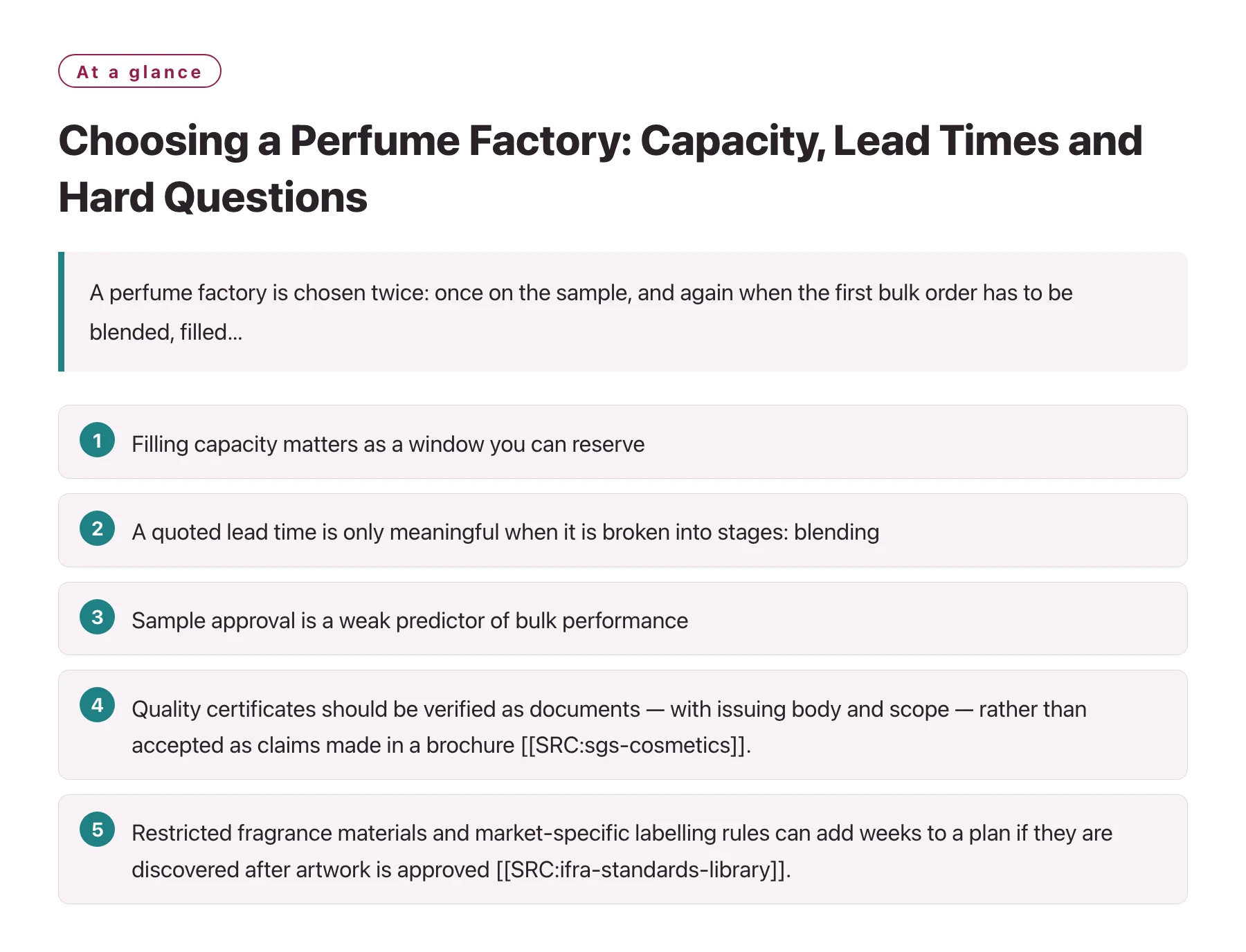
Key takeawaysFilling capacity matters as a window you can reserve, not as a headline figure, so ask which weeks are already committed before planning a launch date. · A quoted lead time is only meaningful when it is broken into stages: blending, resting, filling, assembly, packing and documentation. · Sample approval is a weak predictor of bulk performance, because the bulk batch is blended, rested and filled on different equipment at a different scale. · Quality certificates should be verified as documents — with issuing body and scope — rather than accepted as claims made in a brochure [1]. · Restricted fragrance materials and market-specific labelling rules can add weeks to a plan if they are discovered after artwork is approved [2].
Supplier selection in this industry usually starts with a brief and a set of samples. That is a reasonable way to compare olfactive direction and a poor way to compare factories. Two suppliers can return samples of similar quality and still be very different businesses once a purchase order arrives.
The differences show up in scheduling. One factory blocks a filling window and protects it. Another accepts every order and then sequences the work by whoever presses hardest. Buyers experience the difference as delay, and they usually blame the formula, the components or the market.
This article sets out how to read capacity and lead time as operational facts rather than sales language, what to inspect during a visit, and which answers should make you keep looking.
Capacity is a calendar, not a showroom number
When a supplier says it has capacity, the useful follow-up question is: available in which weeks, on which line, and for which format? Filling capacity is consumed by specific jobs. A line set up for glass bottles cannot absorb a job that needs aluminium cans or a rollerball assembly without a changeover, and changeovers consume exactly the days the schedule was supposed to protect.
So the practical unit of capacity is a reserved window. If a supplier cannot say which weeks are still open, the number behind the claim is not being used for planning.
Ask what else is booked in the same weeks
Seasonal demand compresses the calendar. Most fragrance and personal care programmes aim at the same retail windows, which means inquiries arrive in clusters and filling lines saturate months before the shipping deadline. A supplier who maps those clusters openly is easier to plan with than one who promises everything to everyone.
The question is not whether the factory is busy, but how it decides which jobs move when two orders collide. Escalation rules, deposit dates and artwork deadlines usually reveal the answer better than any statement about daily output.
Certification is a document check, not a feeling
Quality systems are part of capacity, because a factory that cannot release a batch cannot ship it. Cosmetics manufacturers are audited against recognised GMP and quality management standards, and third-party testing laboratories publish the scope of the tests they perform, which makes it straightforward to confirm what a certificate actually covers [1].
Ask for the certificate number, the issuing body and the scope of the audit, then verify it independently. A supplier with nothing to hide will hand over those details in the first meeting rather than promising to send them later.
Manufacturers that carry a documented portfolio of management system certificates — the Guangzhou-based house Xuelei, which describes 31 years of fragrance manufacturing, is one example — tend to treat that verification as routine business rather than as an intrusion.
A supplier review you can complete in one visit
- Walk the filling hall, not the meeting roomAsk to see where bottles are filled, capped and labelled while a job is actually running, and check that the area you see matches the scope on the certificate.
- Trace one order end to endPick a recent shipment and follow it from compound blending through resting, filling, packing and documentation. Gaps in that story are where your delay will appear.
- Ask who fills when the line is fullSome factories sub-contract filling during peak periods. That is not automatically wrong, but it has to be declared in writing and audited the same way.
- Read the lead time as stagesRequest the quote with days attached to each stage, so you can see where resting, testing and documentation sit and which parts can overlap.
- Test the sample-to-bulk linkAsk how the approved reference is retained and how a bulk batch is compared against it before release, and ask to see one such record.
- Confirm the paperwork routeEstablish who prepares safety documentation, ingredient declarations and shipping papers, and how many working days each of those steps normally needs.
Answers worth listening to, and answers worth doubting
| Question to ask | Reassuring answer | Warning sign |
|---|---|---|
| Which weeks are open for filling? | Specific windows, plus the deposit date that holds them | General reassurance that capacity is never a problem |
| What does the lead time include? | A stage-by-stage schedule with resting, testing and packing days | One number of weeks with no breakdown behind it |
| Who runs the filling line? | In-house lines named, with any sub-contracting declared in writing | Vague references to partner workshops or friendly factories |
| How is bulk compared to the approved sample? | A retained reference and a documented comparison before release | Assurance that the formula is identical, with no record kept |
| What happens if a material becomes restricted? | A named contact who flags reformulation needs early and in writing | Silence, or a promise that the formula will never change |
One column of this table deserves more attention than the other two. Warning signs are rarely dramatic; they are small evasions that repeat. A supplier who cannot produce a schedule on request will not produce one under pressure either, and the pressure arrives exactly when you have least room to change course.
Where timelines actually break
Delays in fragrance projects are usually attributed to manufacturing, and they usually begin earlier. Two causes account for most of the slippage buyers experience: documentation that starts too late, and a formula change that arrives after artwork has been signed off.
Neither is a manufacturing failure in the narrow sense, which is why neither shows up in a factory tour that only covers the filling line.
Restricted materials and late reformulation
Aroma materials carry use limits and labelling thresholds that vary by product category and by market. When a formula contains a restricted material close to its allowance, a small change in concentration or a change in the standard itself can force a reformulation [2].
If that is discovered after label artwork, cartons and dielines are approved, the cost is not only the new compound but the whole packaging run. Ask which materials in your formula have the least headroom and treat that short list as a risk register that you review at each project stage.
Artwork and component lead times run in parallel
Bottles, caps, pumps and cartons have their own lead times, and they are often longer than the fragrance itself. Projects that sequence them after formula approval give away the overlap they could have had for free.
The useful discipline is to start component sourcing once the olfactive direction is agreed rather than once the formula is final. Colour and decoration can still be locked later; a mould and a pump cannot.
The first bulk order is a rehearsal
Even a well-run first order is slower than the second one. Tooling is set up, filling parameters are tuned, and the packing line learns the format. Buyers who build that learning curve into the plan rarely miss the retail date; buyers who assume the first order runs at steady-state speed usually do.
For a structured version of the same questions, see how to choose a perfume factory.
The most expensive supplier decision is not choosing the wrong factory; it is choosing at the wrong moment. Signing before the filling window is confirmed converts a scheduling problem into your problem, because the deposit is paid and the launch date has already been shared with buyers. Ask for the filling window, the stage-by-stage lead time and the list of materials with the least regulatory headroom before any deposit is sent, and keep the answers in writing. If one of the three cannot be produced, the honest conclusion is that the project has not been planned yet — which is a far cheaper thing to learn today than in the week the containers are booked.
Sources
- SGS: Cosmetics, Personal Care & Household Testing —— Testing, inspection and certification services for cosmetics and personal care, including microbiological, stability and safety testing aligned with cosmetics GMP.
- IFRA Standards Library (International Fragrance Association) —— The IFRA Standards Library lists the restrictions the fragrance industry applies to individual fragrance ingredients, based on safety assessments; it is the reference point for compliant fragrance formulation.
Frequently asked questions
How long should a perfume factory take to deliver a bulk order?
There is no single defensible figure, because the clock covers blending, a resting period, filling, assembly, packing and documentation. What matters is that the quote breaks the timeline into stages with days attached. A supplier who answers with one number is describing an expectation rather than a schedule you can plan against.
Is a lower price a sign of a weaker factory?
Not on its own. Price differences usually come from the fragrance compound, the components and the packing labour rather than from quality systems. Compare the quote item by item, and treat a large gap as a question to ask rather than a conclusion to draw about capability.
What documents should I request before placing a first order?
Ask for the GMP certificate with its issuing body and audit scope, the safety documentation for the finished product, the ingredient and allergen declaration route, and a written stage-by-stage schedule. Certificates should be verifiable independently, and third-party test reports should name the laboratory and the tests performed.
Do I need to visit the factory in person?
A visit is the fastest way to confirm that filling, assembly and packing happen where you were told. If travel is not possible, ask for a live walk-through on video covering the same stations, and request the batch record for a recent order of comparable format and volume.
What should a supply agreement say about timing?
It should name the filling window, the deposit date that holds it, the stage-by-stage lead time, and the process for handling changes after artwork approval. Language about best efforts is not a schedule, and it will not help when a retail date is fixed and the container is due.