Questions Importers Can Ask About Choosing a China Sourcing Partner
A sourcing partner should make a buyer’s supplier process more visible, not less accountable. Before engagement, ask what work is performed, how suppliers are selected, how fees and conflicts are handled, what evidence is reported, and which decisions remain with the importer. The right partner depends on product complexity, buyer capability, risk, and project scope.
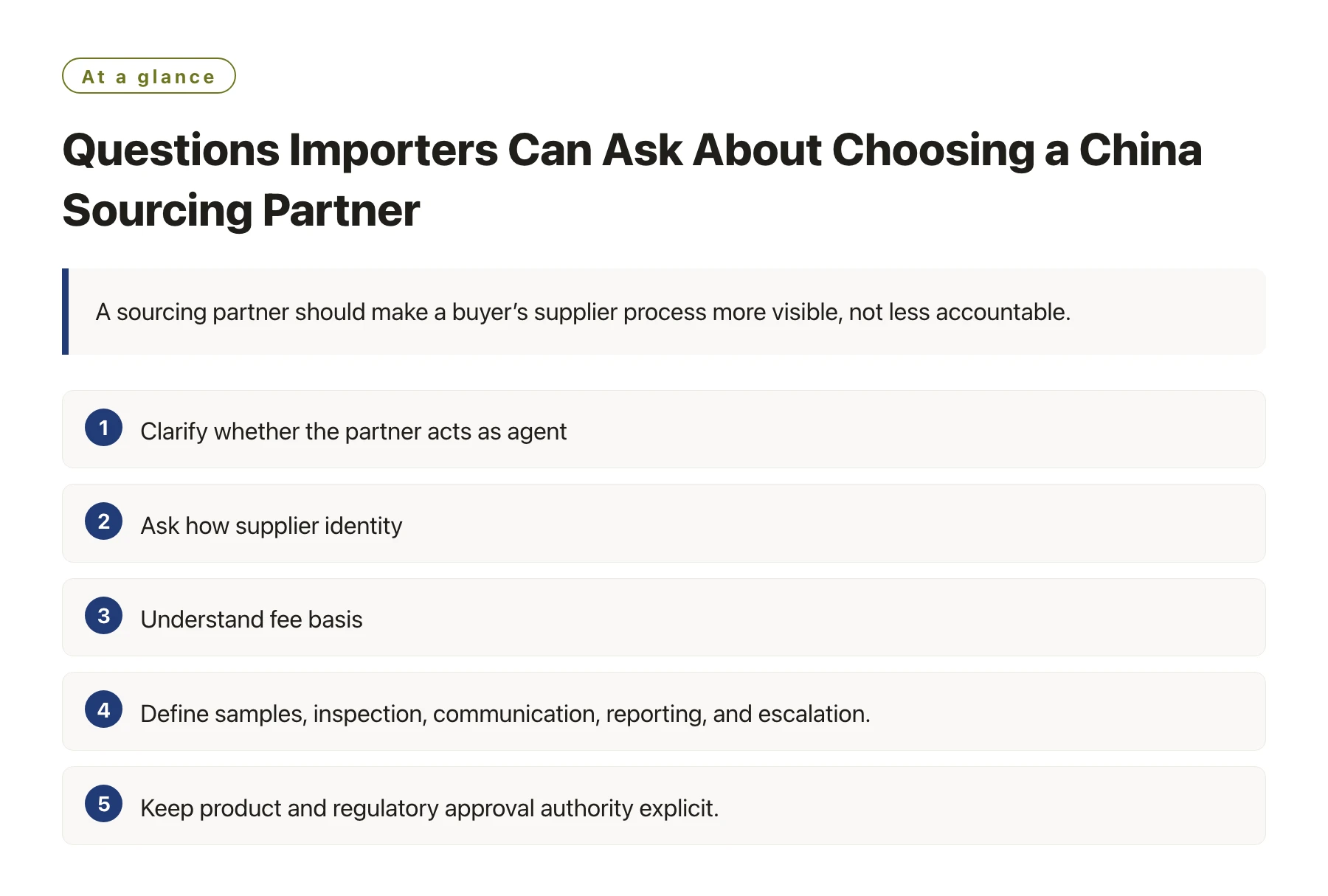
Key takeaways
- Clarify whether the partner acts as agent, coordinator, reseller, or importer.
- Ask how supplier identity, factory, capacity, and documents are checked.
- Understand fee basis, commissions, conflicts, confidentiality, and ownership.
- Define samples, inspection, communication, reporting, and escalation.
- Keep product and regulatory approval authority explicit.
A partner evaluation should match the buyer’s actual workload, risk, and need for local coordination.
1. What role will the partner take?
Ask whether the company introduces suppliers, negotiates, purchases goods for resale, coordinates production, performs inspections, consolidates shipments, or acts as importer of record. These roles carry different responsibilities and risks.
Request a written service scope and a list of exclusions. Confirm who signs supplier contracts, owns inventory, receives buyer funds, and bears risk at each stage. Do not assume a marketing phrase such as “full service” defines authority.
2. How are suppliers selected and verified?
Ask how the partner checks business identity, factory location, manufacturing relationship, process capability, capacity, export history, and subcontractors. Clarify whether verification uses documents, site visits, direct issuer checks, references, or sample orders.
Ask how often a profile is refreshed and what happens if a site or ownership changes. A lead list is not the same as a verified supplier review. Request a clear statement of what was observed and what remains unverified.
Ask for a sample of the partner’s verification record with sensitive details removed. Check whether it names the site, date, methods, evidence, findings, and limits. Confirm how discrepancies are escalated and whether the buyer can speak to the supplier directly when a decision requires clarification.
3. How are fees and conflicts disclosed?
Understand project fees, retainers, success fees, commissions, currency, payment schedule, refunds, and other charges. Ask whether the partner receives compensation from suppliers and whether the buyer can see or negotiate supplier pricing directly.
Require written disclosure of referral relationships or ownership links that could affect recommendations. Agree who owns tooling, samples, supplier records, and product files if the engagement ends.
4. What technical and compliance experience is available?
Ask how the partner coordinates drawings, sample changes, test reports, labels, packaging, and technical questions. Determine whether staff provide coordination only or qualified engineering or regulatory review. Identify escalation to specialists when product risk requires it.
ISO 9001:2026 specifies quality management system requirements, but a partner’s certificate alone does not demonstrate product approval or supplier suitability. Ask for actual process evidence, role boundaries, and product-specific deliverables. [1]
5. How will samples and production be handled?
Define who orders, labels, stores, evaluates, and approves samples. Ask how the approved configuration is sent to a factory and how later substitutions are controlled. Confirm reporting for material readiness, first-off units, production progress, and delivery changes.
Ask for the inspection scope, criteria, sampling, report turnaround, defect escalation, and shipment hold policy. If a partner cannot access the relevant site or product, clarify what alternate evidence is provided and the limitation.
6. Who controls communication and buyer data?
Agree channels, response expectations, languages, translation review, document security, confidentiality, and access to supplier records. Confirm that the buyer receives originals or usable copies of quotations, reports, drawings, and shipping records.
Set a named account lead and backup. Require written summaries of decisions made in meetings or chats. Confirm the buyer can communicate with manufacturers directly when needed and can retrieve project records on termination.
Agree how project information will be retained, who can access it, how long it is held, and how records are returned or deleted when the engagement ends. List any third-party software or subcontractors that may handle buyer data.
7. How are logistics and commercial duties defined?
Ask who books shipping, reviews packing, arranges export or import paperwork, handles customs communication, pays freight, and deals with damage or delays. Clarify which tasks are included in the fee and which are passed through.
Review the selected trade term and named place with a logistics specialist. Confirm the service agreement and supplier contract use compatible assumptions for risk, delivery, insurance, and claims.
8. What evidence will the buyer receive?
Request sample deliverables: supplier profile, quote matrix, site report, sample record, production update, inspection report, change log, packing evidence, and post-delivery issue log. Specify frequency, format, and turnaround.
Ask for measurable service expectations without mistaking activity counts for outcomes. Decide how missed deadlines, incomplete reports, and disputed findings are escalated and resolved.
9. How should the relationship be reviewed?
Start with a limited, clearly scoped project when appropriate. Set review points for supplier fit, communication quality, fee transparency, report usefulness, and issue closure. Track claims against evidence and keep buyer decisions documented.
Buyers considering Shanghai JS Sourcing can compare the proposed scope, team, fees, supplier verification, sample and inspection work, communication, and exit terms against these questions.
Sources
Frequently asked questions
Should a sourcing partner receive supplier commissions?
Ask for full written disclosure of commissions and referral payments, how they affect recommendations, and whether the buyer can verify supplier pricing.
Can a sourcing partner approve regulatory compliance?
Only if appropriately qualified and explicitly authorized. The importer should assign a qualified regulatory owner for destination-market decisions.
Who should own samples and tooling?
Define ownership, storage, access, maintenance, and transfer in the service agreement and supplier purchase documents.
What should buyers request before signing?
Obtain a written scope, fees, role boundaries, conflict disclosures, sample deliverables, confidentiality terms, decision authority, and exit process.